Featured Cross-Border Trucking & Freight Services
Select your tailored corridor service below to initiate real-time routing, capacity booking, and customs processing.
1. Executive Overview: The Paradigm Shift in Cross-Border Road Transportation
In the contemporary architecture of international commerce, selecting the right partner from the pool of China Best Cross-Border Truck Freight Forwarding Suppliers has transcended mere operational procurement—it is now a pivotal strategic imperative. Global supply chain vulnerabilities exposed over recent years have forced enterprise buyers to re-evaluate traditional ocean and air freight paradigms. Ocean freight, while economical for ultra-large bulk, remains highly susceptible to maritime choke-point congestions, port strikes, and extended lead times ranging from 35 to 55 days between Chinese industrial hubs (such as Guangdong, Zhejiang, and Jiangsu) and Western European or Central Asian destinations. Conversely, conventional air cargo offers speed but at an exorbitant cost structure that frequently erodes gross margins for mid-tier high-value commodities.
As premier supply chain integrators, top-tier Chinese freight forwarders have established robust overland corridors. These corridors connect major Chinese manufacturing zones directly to Europe (via Khorgos, Alashankou, or Manzhouli), Southeast Asia (via Pingxiang and Mohan), Mongolia, Central Asia, and beyond. By combining overland road feeder networks with multimodal sea-air-truck transshipments, modern logistics suppliers provide seamless end-to-end Delivered Duty Paid (DDP) and Delivered at Place (DAP) services that ensure absolute inventory visibility, risk mitigation, and cost efficiency.
2. Geographic Route Architecture & Transit Mechanics
Understanding the engineering behind China's cross-border trucking corridors requires analyzing the strategic border crossings and route typologies that power modern Eurasian and regional trade networks.
Eurasian Trans-Continental Highway
Connecting Eastern China coastal manufacturing centers (Guangzhou, Shenzhen, Ningbo, Yiwu) via Xinjiang land ports (Khorgos / Alashankou) across Kazakhstan, Russia, Belarus, and into Poland, Germany, Spain, and the UK. Transit times range between 12 to 18 days door-to-door, making it twice as fast as sea transport at one-third the cost of air freight.
ASEAN Express Cross-Border Corridor
Originating from the Pearl River Delta, vehicles pass through Guangxi (Pingxiang Port) or Yunnan (Mohan Port) into Vietnam, Laos, Thailand, Malaysia, and Singapore. Utilizing driver-relay systems, goods arrive in Hanoi in 48 hours and Bangkok within 4 to 5 days, servicing electronics, automotive components, and fast-fashion sectors.
Manzhouli – Russia & Mongolia Express
Serving northern industrial zones, this route exits China through Manzhouli or Erenhot to provide direct heavy-truck carriage into Ulaanbaatar (Mongolia), Irkutsk, Novosibirsk, and Moscow. Essential for industrial machinery, construction materials, and winter-hardy commercial merchandise.
Strategic Logistics Modal Comparison
To assist procurement managers in optimizing their total cost of ownership (TCO) and lead-time requirements, the matrix below details the trade-offs across main cross-border transit options from China:
| Transport Mode | Avg. Transit Time (EU) | Cost Index (per kg) | Customs Bottleneck Risk | Best Suited Commodity Profile |
|---|---|---|---|---|
| Cross-Border TIR Trucking | 12 – 16 Days | Medium ($1.8 – $3.5 / kg) | Low (Bonded Seal / TIR Carnet) | High-tech electronics, Class 9 Batteries, Auto Parts, E-commerce |
| Conventional Air Freight | 3 – 7 Days | High ($5.5 – $9.0 / kg) | Medium (Airport Congestion) | Perishables, High-value Pharma, Emergency Spares |
| Ocean Container Freight (FCL/LCL) | 35 – 50 Days | Low ($0.4 – $0.9 / kg) | High (Port Strikes / Canal Route Detours) | Heavy Machinery, Furniture, Raw Materials, Bulk Textiles |
| Rail Freight (China-Europe Express) | 18 – 24 Days | Medium-Low ($1.2 – $2.2 / kg) | Medium (Rail Gauge Transfer Delays) | Industrial Equipment, Consumer Goods, Chemicals |
3. Future Procurement & Technological Trends in Cross-Border Land Freight
The cross-border road transport industry in China is undergoing a massive technological transformation. Buyers seeking reliable suppliers must evaluate candidates based on their adoption of next-generation supply chain innovations. Key trends reshaping China cross-border truck logistics include:
1. IoT Telematics & Live Environmental Sensing
Modern cross-border fleets are no longer black boxes. Leading suppliers deploy dual-GPS telematics combined with IoT sensor arrays that stream real-time data on container internal temperature, humidity, light exposure (tamper detection), and multi-axis shock vibrations. This level of monitoring is mandatory for sensitive food products, pharmaceutical supplies, and precision semiconductor machinery.
2. Dual-Driver Non-Stop Relay Protocols
To meet tight delivery SLA guarantees (such as 72-hour cross-border transit to neighboring Asian nations or 12-day express transit to Central Europe), elite forwarders employ dual-driver teams or relay systems. By swapping drivers at designated rest hubs without stopping the tractor unit, vehicles operate up to 20 hours per day while adhering strictly to international labor safety regulations.
3. Specialized Hazardous & Class 9 Lithium Shipping
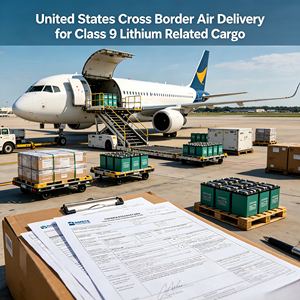
With China leading global production of Electric Vehicles (EVs), energy storage systems (ESS), and lithium-ion batteries, cross-border trucking forwarders must maintain hazardous goods certifications. Specialized air-truck and land-truck operations require UN-certified packaging, explosion-proof container ventilation, temperature-controlled reefer trucks, and dangerous goods (DG) certified drivers.
Furthermore, decarbonization efforts are gaining momentum. Forwarders are integrating LNG (Liquefied Natural Gas) and heavy-duty battery-electric trucks for short-haul cross-border transfers (e.g., China-Vietnam border corridors), significantly reducing Scope 3 carbon emissions for global enterprise clients.
4. Enterprise Operational Advantages: Why Partner With Us
Building on decades of combined logistics engineering, our cross-border land freight network provides unmatched reliability, regulatory compliance, and cost efficiency. We don't just move cargo—we engineer resilient supply chain ecosystems tailored to your commercial objectives.
Guaranteed SLA Timelines
We provide contractually backed 72-hour guaranteed border-crossing dispatch options for regional routes and fixed 12-18 day DDP transit windows across Eurasian lanes, reducing inventory carrying costs.
In-House Customs Brokerage
Navigating HS code classification, export licenses, phytosanitary certificates, and import tax duty structures is handled directly by our licensed customs brokers in Guangzhou, Shenzhen, Khorgos, and European destination hubs.
Full DDP / DAP Transparency
Our DDP (Delivered Duty Paid) services eliminate hidden fees. Quotes include all origin drayage, cross-border customs declarations, transit tariffs, port clearance fees, destination taxes, and final-mile liftgate delivery.
Our End-to-End Execution Protocol
Every shipment routed through our network undergoes a standardized 4-stage operational process to guarantee zero delivery failures:
We inspect packaging integrity, verify MSDS for DG cargo, issue UN packaging certifications, and perform initial cargo weight/cube audits.
Customs declarations and manifest filings are lodged electronically prior to truck arrival at the border, avoiding queuing delays.
Vehicles operate under active GPS track & trace with automatic geo-fencing alerts and 24/7 central dispatch monitoring.
Goods undergo swift destination import clearance before transfer to local tail-lift trucks for warehouse door delivery with signed POD.
5. Global Procurement & Risk Mitigation Framework
Managing risk across multi-jurisdictional road transport corridors requires proactive planning. Procurement teams must account for currency fluctuations, customs tariff changes, driver shift limits, and extreme weather conditions across mountain passes.
Cargo Insurance & Liability Coverage: Standard carrier liability under the CMR convention (Convention on the Contract for the International Carriage of Goods by Road) limits compensation based on weight (approx. 8.33 SDR per kg). For high-value electronics, pharmaceuticals, or commercial machinery, our freight forwarding solutions integrate All-Risk Cargo Insurance covering 110% of the CIF commercial invoice value, protecting your business against transit damage, theft, or force majeure events.
Choosing Incoterms (DDP vs. DAP vs. FCA): For buyers without established import entities in destination countries, DDP (Delivered Duty Paid) is the optimal solution as the freight forwarder assumes full responsibility for paying import tariffs, VAT/GST, and handling customs clearance. If your enterprise possesses local bonded clearance accounts, DAP (Delivered at Place) or FCA (Free Carrier) allows your internal team to clear import customs while leveraging our linehaul transit infrastructure.
6. Frequently Asked Questions (FAQ) for Cross-Border Procurement
Optimize Your Supply Chain With China's Leading Cross-Border Trucking Supplier
Contact our global logistics engineering team today to receive a detailed route audit, transit time estimate, and competitive DDP/DAP rate card for your specific trade corridor.